
Amazon S3 connector
Use the s3: scheme in sink.connect. The S3 connector is sink-only. It writes
either one object per row (object-per-row) or one object for the whole
transfer (file mode). Only mode=complete is supported. Each object is uploaded
on its own, so there is no transaction across objects.
Connection
Section titled “Connection”The sink.connect URI gives the endpoint host, an optional port, and the
bucket as its path: s3://<host>[:port]/<bucket>. Use s3.<region>.amazonaws.com
for AWS. Path-style access is used.
All S3 properties are set under sink.connect.parameter.*.
Properties
Section titled “Properties”| Parameter | Description | Default |
|---|---|---|
accessKey |
Access key ID. Required; an empty value fails. | none |
secretKey |
Secret access key. Required; an empty value fails. It is masked in toString() output. |
none |
secure-connection |
true uses HTTPS. false uses HTTP for the endpoint. |
true |
row.isObject |
true selects object-per-row mode. false selects file mode. |
false |
row.keyColumn |
Column whose value is the object key. Required when row.isObject=true. |
none |
row.contentColumn |
Column whose value is the object body. Required when row.isObject=true. |
none |
keyFileName |
Object key in file mode. Read only in file mode. | Last segment of the bucket path |
Credentials must come from an environment-managed secret. Do not put resolved keys in a committed properties file, command history, or logs.
Object-per-row mode
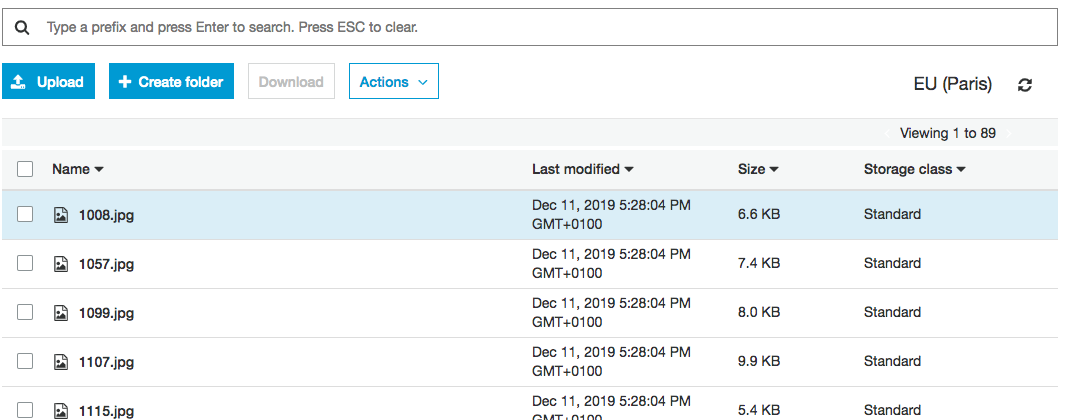
Section titled “Object-per-row mode”With row.isObject=true, each row becomes one object. The value of
row.keyColumn is the object key and the value of row.contentColumn is the
object body. Binary, BLOB, and CLOB values are written as byte streams. The
sink file format (sink.file.format) is not used in this mode.
mode=completesource.connect=${SOURCE_CONNECTION}sink.connect=${S3_ENDPOINT_AND_BUCKET}sink.connect.parameter.accessKey=${S3_ACCESS_KEY}sink.connect.parameter.secretKey=${S3_SECRET_KEY}sink.connect.parameter.secure-connection=truesink.connect.parameter.row.isObject=truesink.connect.parameter.row.keyColumn=${KEY_COLUMN}sink.connect.parameter.row.contentColumn=${CONTENT_COLUMN}File mode
Section titled “File mode”With row.isObject=false, all rows are streamed into one object in the format
set by sink.file.format (csv or orc; see the
CSV and local file connector for format options).
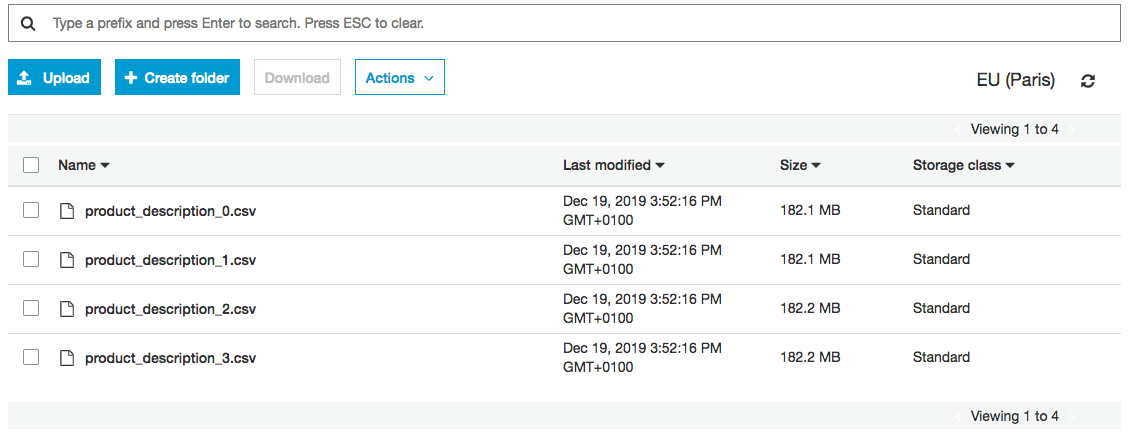
The object key is keyFileName, or the last segment of the bucket path when it
is not set. When the job runs with more than one parallel task, each task
writes its own object: _<taskId> is inserted before the file extension of
keyFileName.
mode=completesource.connect=${SOURCE_CONNECTION}sink.connect=${S3_ENDPOINT_AND_BUCKET}sink.connect.parameter.accessKey=${S3_ACCESS_KEY}sink.connect.parameter.secretKey=${S3_SECRET_KEY}sink.connect.parameter.secure-connection=truesink.connect.parameter.row.isObject=falsesink.connect.parameter.keyFileName=${S3_OBJECT_KEY}sink.file.format=csvReplication modes and limits
Section titled “Replication modes and limits”- Only
completeis supported. The S3 manager does not implementincrementalorcomplete-atomic. - The connector is sink-only. It cannot be used as a source.
- There is no transaction across objects. Each object is uploaded on its own, so a failure part-way through leaves the objects already written in place.